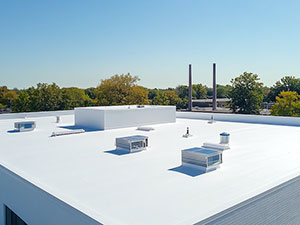
Large commercial buildings place unique demands on flat roofing systems. Warehouses, retail centers, office complexes, and industrial facilities in Missoula, MT rely on flat roof waterproofing to protect interior operations, assets, and structural components. At Schrock Roofing, we work with commercial property owners and facility managers to address the challenges that arise when waterproofing expansive flat roof systems. For commercial flat roof waterproofing support, call (406) 961-2990.
Flat Roof Waterproofing Challenges
Unlike smaller roofs, large commercial flat roofs are exposed to greater surface area, heavier foot traffic, and more complex drainage patterns. These factors increase the likelihood of water intrusion if waterproofing is not properly designed. Understanding these challenges is the first step toward building a durable and reliable flat roofing system.
Before examining solutions, it is important to recognize that most waterproofing failures on commercial roofs are not caused by a single issue. They are typically the result of multiple stress points acting together across a large surface. Proper flat roof waterproofing addresses each of these risks as part of a coordinated system rather than a single layer of protection.

Surface Area and Water Volume
Large commercial roofs collect significantly more water during rain and snow events than smaller structures. The greater the surface area, the more water must be directed toward drains efficiently. Even minor low spots can turn into widespread ponding areas on expansive roofs.
Effective flat roof waterproofing accounts for water volume by creating continuous protection across the entire surface. Liquid applied and membrane based systems are designed to maintain consistent thickness, reducing weak points where water pressure can compromise the roof. When waterproofing is applied evenly and integrated with drainage planning, the roof can handle higher water loads without increased failure risk.
Flat Roof Drainage Limitations
Drainage is one of the most common challenges on large flat roofs. Long distances between drains, rooftop obstructions, and aging infrastructure can slow water movement and cause ponding.
Proper flat roof waterproofing works in tandem with drainage design. Waterproofing systems are reinforced around drains, scuppers, and transition points to prevent leaks where water concentrates. In many commercial applications, waterproofing is combined with surface leveling or slope correction to guide water toward drainage points more efficiently.
Rooftop Equipment and Penetrations
Commercial roofs often support HVAC units, exhaust systems, piping, and electrical infrastructure. Each penetration introduces a potential entry point for moisture, especially as buildings expand or equipment is replaced over time.
Flat roof waterproofing systems address this challenge by creating reinforced seals around penetrations. Liquid applied waterproofing is particularly effective in these areas because it conforms to irregular shapes and creates a continuous barrier around curbs and bases. This reduces reliance on mechanical fasteners or overlapping materials that can loosen over time.
Thermal Movement and Structural Stress
Large commercial buildings experience constant expansion and contraction due to temperature changes. In climates like Missoula, MT, freeze thaw cycles amplify this movement, placing stress on roofing materials.
High quality flat roof waterproofing systems are designed to remain flexible under thermal stress. Elastomeric and reinforced membranes move with the building rather than cracking or separating. This flexibility helps maintain waterproof integrity even as the roof structure shifts throughout the year.
Aging Roof Substrates
Many commercial buildings operate with older roof systems that were not originally designed for modern waterproofing methods. Uneven substrates, legacy materials, and previous repairs can complicate waterproofing applications.
Proper flat roof waterproofing begins with surface evaluation and preparation. Compatible systems are selected based on existing materials, ensuring proper adhesion and performance. By addressing substrate conditions before application, waterproofing systems can extend roof life without introducing new failure points.
Foot Traffic and Maintenance Exposure
Commercial roofs experience more foot traffic than residential roofs due to equipment servicing and inspections. Repeated movement can wear down protective layers and expose vulnerable areas.
Durable flat roof waterproofing systems include reinforced walk paths and wear resistant coatings in high traffic zones. This targeted protection reduces surface degradation while maintaining consistent waterproofing across the rest of the roof.
Flat Roof Waterproofing Experts
One of the biggest challenges on large commercial roofs is treating leaks as isolated problems. Reactive repairs often fail to address underlying system weaknesses.
Effective flat roof waterproofing treats the roof as a unified system. Drainage, penetrations, surface movement, and traffic patterns are all considered together. At Schrock Roofing, we apply flat roof waterproofing solutions that address these challenges holistically for commercial buildings throughout Missoula, MT. To discuss commercial flat roof waterproofing options, call (406) 961-2990.
FAQ
Why are large commercial flat roofs more prone to leaks?
Their size, drainage complexity, and rooftop equipment increase exposure to water intrusion.
Can waterproofing help with ponding water?
Yes, when combined with proper drainage planning and surface preparation.
Are penetrations a major waterproofing concern?
Yes, penetrations are common leak points without reinforced waterproofing.
Does climate affect flat roof waterproofing performance?
Temperature changes and freeze thaw cycles significantly impact material durability.