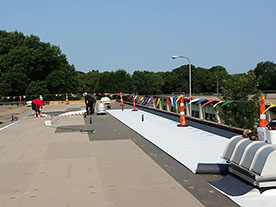
For commercial building owners in Belgrade, MT, understanding how single-ply roofing is installed can make it easier to evaluate bids, plan timelines, and ensure long-term roof performance. Single-ply roofing systems, such as TPO, PVC, and EPDM, are popular for commercial buildings due to their durability, flexibility, and energy efficiency. However, their success depends heavily on proper installation, from the initial deck preparation to the final welded seams. If you’re considering a new roof system in Belgrade, MT, call (406) 961-2990 to speak with Schrock Roofing about professional installation options tailored to your building.
How Single-Ply Roofing Is Installed
Roof Deck Preparation Sets the Stage
Every successful single-ply roofing installation begins with thorough deck preparation. The roof deck is the structural surface that supports the entire roofing system, and any flaws at this stage can compromise performance later.
First, the existing roof surface is evaluated. Depending on conditions, old materials may be removed entirely, or a retrofit installation may be possible. The deck is then cleaned, dried, and inspected for damage such as rust, rot, cracks, or uneven areas. Structural repairs are completed before moving forward.
Once sound, the deck must be smooth and secure. Protruding fasteners, debris, or moisture can interfere with insulation attachment and membrane adhesion. Proper deck preparation ensures the single-ply membrane lies flat, reducing stress points that could lead to leaks or premature wear.
Insulation and Vapor Barriers
After the deck is ready, insulation boards are installed. Insulation plays a major role in energy efficiency, helping commercial buildings regulate indoor temperatures and reduce heating and cooling costs. The thickness and type of insulation are chosen based on building use, climate conditions, and local energy codes.
Insulation boards are typically fastened mechanically or adhered with approved adhesives. Precision is critical, gaps or uneven placement can create thermal bridges that reduce efficiency and lead to condensation issues.
In many commercial applications, a vapor barrier is also installed. Vapor barriers prevent moisture from migrating upward from inside the building into the roofing system, where it could condense and damage insulation or the membrane. This layer is especially important in climates with temperature fluctuations, making it a key step in long-term roof performance.

Installing the Single-Ply Membrane
Once insulation and barriers are in place, the single-ply membrane installation begins. Single-ply roofing membranes are manufactured in large sheets, which minimizes the number of seams compared to other roofing systems.
The membrane is rolled out carefully across the roof surface and positioned according to the layout plan. Depending on the system design, membranes may be:
- Mechanically fastened along seams
- Fully adhered using specialized adhesives
- Ballasted with approved materials (less common in some regions)
Proper alignment is essential to avoid wrinkles, tension, or misaligned seams. The membrane must be allowed to relax before final attachment so it can adjust to temperature conditions and prevent future movement.
Seams, Flashings, and Edge Details
The final, and most critical, phase of single-ply roofing installation is sealing the seams and detailing roof penetrations. Seams are typically heat-welded or chemically bonded, creating a continuous, watertight surface. When done correctly, welded seams can be stronger than the membrane itself.
Flashing installation follows, sealing areas around HVAC units, vents, skylights, drains, and parapet walls. These penetrations are common leak points if not handled precisely. Prefabricated accessories or custom-cut membrane pieces are used to ensure tight transitions.
Finally, perimeter edges are secured with termination bars, coping systems, or metal edging. These details protect the membrane from wind uplift and water intrusion while giving the roof a finished appearance.
Why Proper Installation Matters for Commercial Buildings
Single-ply roofing offers excellent durability, but only when installed correctly. Each phase, from deck prep to final seams, works together as a system. Skipping steps or rushing installation can lead to leaks, energy loss, and shortened roof lifespan.
For commercial building owners, understanding this process helps set realistic expectations and emphasizes the value of professional workmanship over shortcuts.
Single-Ply Roofing Experts
If your facility in Belgrade, MT is considering single-ply roofing, proper installation is key to long-term performance and protection. To discuss system options, installation planning, or technical details, contact Schrock Roofing at (406) 961-2990 for expert guidance tailored to your commercial property.
FAQ
What types of buildings are best suited for single-ply roofing?
Single-ply roofing is ideal for flat or low-slope commercial buildings such as warehouses, offices, retail centers, and industrial facilities.
How long does a single-ply roofing installation typically take?
Project timelines vary based on roof size, weather conditions, and system type, but many commercial installations are completed efficiently compared to traditional systems.
Are single-ply roofing seams watertight?
Yes, when properly heat-welded or bonded, seams form a continuous waterproof barrier.
Can single-ply roofing be installed over an existing roof?
In some cases, yes, if the existing roof meets structural and moisture requirements, a retrofit installation may be possible.