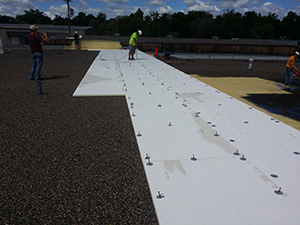
Commercial buildings in Great Falls face persistent wind, cold winters, temperature swings, and strong summer sun. For low-slope roofs, the membrane system must handle these conditions while giving property owners a practical balance of performance and long-term ownership costs. TPO roofing uses a single-ply thermoplastic polyolefin membrane, typically with a white reflective surface and heat-welded seams.
Call Schrock Roofing at (406) 961-2990 for TPO roofing in Great Falls, MT.
TPO Roofing for Great Falls Wind Conditions
Wind is a significant consideration for commercial properties in Great Falls. The city’s location in north-central Montana exposes buildings to persistent winds, making membrane attachment and seam integrity important parts of roof performance.
Heat-welded seams are one of TPO’s key advantages. Instead of relying on adhesive at membrane seams, heat welding fuses adjoining sections together. A properly welded seam creates a strong bond that can help the roof resist wind uplift and limit the chance of separation as the system ages.
The membrane is also available in mechanically attached and adhered assemblies, allowing the roofing system to be selected around the building’s structure and wind requirements. Proper attachment remains essential, since the membrane itself is only one part of the roof assembly.
Reflective TPO Roofing for Summer Sun

Great Falls experiences warm, sunny summers, with July high temperatures commonly reaching the mid-to-upper 80s. A typical white TPO surface reflects a significant portion of incoming solar energy instead of absorbing as much heat as a darker roof surface.
Lower roof surface temperatures can reduce heat transfer into the building during hot weather. For commercial properties with large roof areas, that characteristic can support lower cooling demand, particularly when the building is air conditioned throughout the summer.
Solar reflectivity also contributes to rooftop comfort and can reduce thermal stress on the membrane. This does not eliminate the need for proper insulation or ventilation, but it can be a useful part of an overall energy strategy for a commercial building.
TPO Roofing Handles Montana Temperature Swings
Great Falls roofs must perform through cold winters, warm summers, and seasonal temperature changes. Roofing materials expand and contract as temperatures change, so flexibility matters for maintaining system performance over time.
TPO is designed to remain flexible across a broad temperature range. This characteristic makes it suitable for Montana conditions where a roof may move through substantial temperature differences between seasons and between daytime and nighttime conditions.
The roof’s long-term performance still depends on installation quality, drainage, insulation, attachment, and regular maintenance. A membrane selected for the local climate cannot compensate for poor detailing or unresolved drainage problems.
TPO Roofing and Long-Term Ownership Value
For commercial building owners, the value of a roofing system extends beyond the initial installation. TPO combines a relatively competitive installed cost with useful performance characteristics, including reflective properties, heat-welded seams, and resistance to common weather stresses.
Cost of ownership also depends on how well the roof is maintained. Regular inspections can identify punctures, damaged flashings, drainage problems, and seam concerns before they develop into larger failures. Addressing these issues early can help protect the original investment and reduce avoidable disruption.
TPO Roofing: A Practical Choice for Great Falls Buildings
TPO roofing offers several characteristics that align well with Great Falls conditions. Heat-welded seams support wind resistance, the reflective surface helps manage summer solar heat, and the membrane’s flexibility suits the region’s broad temperature range.
For TPO roofing in Great Falls, MT contact Schrock Roofing at (406) 961-2990 today.
FAQ
What are the main benefits of TPO roofing for commercial buildings in Montana?
TPO provides a combination of reflective performance, welded seam strength, flexibility, and relatively low ownership costs. These characteristics can make it a practical option for commercial buildings exposed to Montana’s strong sun, wind, and seasonal temperature changes.
How does TPO roofing hold up in Great Falls’ wind and temperature conditions?
A properly designed TPO assembly can perform well in windy conditions because its heat-welded seams create strong membrane connections. The material is also designed to accommodate temperature changes, although attachment and detailing must be appropriate for the specific building.
Is TPO roofing a good long-term investment for a commercial building in north-central Montana?
It can be, particularly when the building benefits from a reflective membrane and needs a cost-conscious low-slope system. The long-term value depends on installation quality, roof design, maintenance, and how well the system matches the property’s operating conditions.